
Suite Studio, Packaging & Cross-Suite Interfaces
When enterprise applications grow beyond a handful of entities, packaging capabilities into reusable, versioned suites keeps bounded contexts clean across teams and deployments. Perlite provides Suite Creation Studio for packaging selective subsets of a domain model, and Interface Builder for defining typed API, event, and message contracts across suite boundaries.
1. Suite Creation Studio & Entity Slicing
Open Object Browser → Architecture & Integration → Suites (🏛️) and click + New Suite from Model (or inspect an imported suite) to launch Suite Creation Studio:
- Suite Metadata (
1. SUITE METADATA): Assign a PascalCase suite identifier, semantic version, category description, and maintainer ownership. - Entity Slicing & Field Projections (
2. ENTITY SLICING & FIELD PROJECTIONS): Choose whole entities or expandSlice Fieldsto project only the exact attributes, relations, and functions belonging inside the suite contract. Sensitive or upstream attributes stay encapsulated in their owning suite. - Screen, Role & Boundary Inclusion (
3. INCLUDED SCREENS): Select composite screens bundled into the package and inspect the real-time Boundary & Peer Dependencies indicator before saving or switching toLive YAML Manifest.
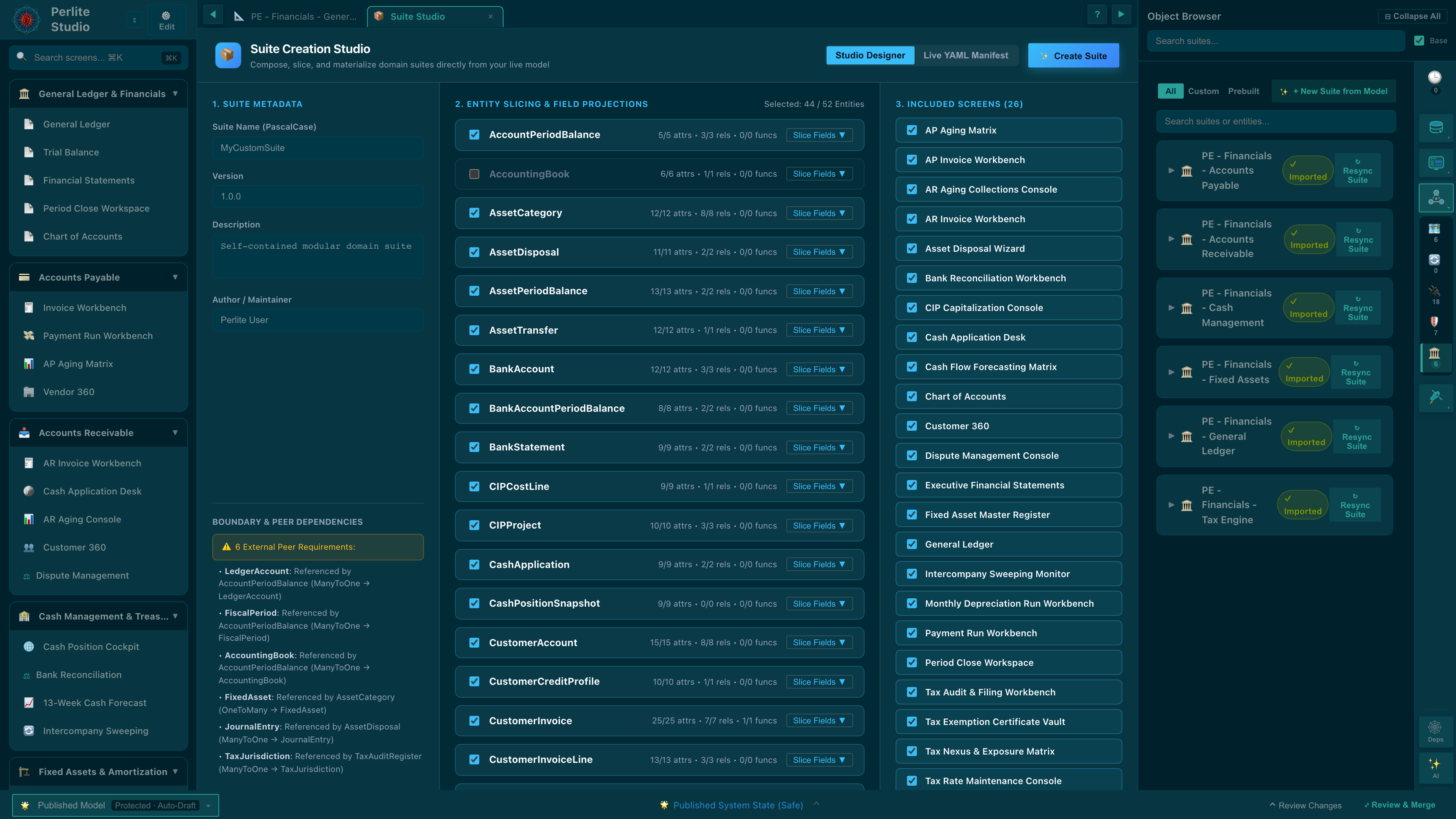
Suite Creation Studio slicing attributes, relations, and composite screens across the 52-entity enterprise model while verifying peer dependency boundaries in real time.
2. Enriched Peer Stubs & Dependency Pinning
Cross-suite foreign keys resolve cleanly inside downstream workspaces without cloning source implementation code:
- Enriched Peer Stubs: Installing an upstream suite (such as PE - Financials - Fixed Assets referencing General Ledger’s
FiscalPeriod) materializes a minimal peer stub preserving primary key identity and inverse collections (such asassetPeriodBalances). - Locked Peer Pinning: Perlite records semantic suite versions and explicit cross-suite dependency rationales (for example pinning Accounts Payable
1.2.0to General Ledger entitiesLedgerAccount,AccountingBook,FiscalPeriod, andJournalEntry), enabling clean upgrades and conflict checks during Resync Suite.
3. Cross-Suite Interfaces & Declarative Triggers
Open Object Browser → Architecture & Integration → Interfaces (🔌) to define cross-suite transport contracts in Interface Builder:
- Tri-Modal Contracts (
API·Event·Message): Every interface declares valid transport modes (REST,Webhook,Queue), direction (INBOUNDorOUTBOUND), and versioned endpoint route (such as/api/interfaces/gl/journal-entry/post). - Typed Entity & Nested Sub-Array Mapping: Drag related entities from
+ Valid Entitiesonto the payload canvas to compose nested header/line structures (JournalEntry+lines: Array [6]mapped directly fromJournalLineattributes). - Zero-Glue Trigger Execution (
⚡ + Trigger): Attach an inbound interface directly to an entity function (CreateOneor custom action handlers) with field-level parameter mappings, enforcing validation pipelines and action points automatically on arrival.
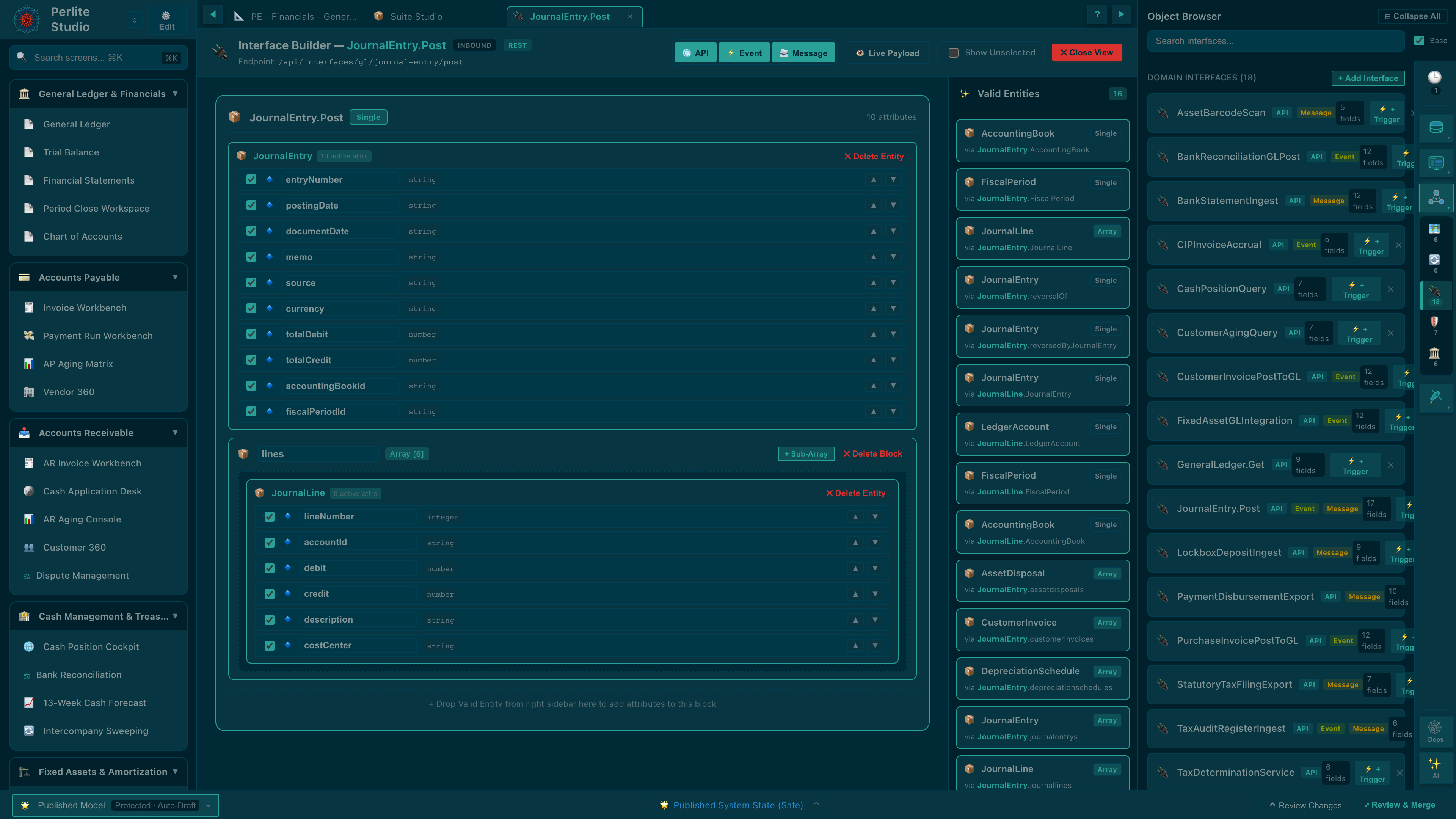
Interface Builder composing JournalEntry.Post with tri-modal API, Event, and Message flags, nested JournalLine line items, and valid entity relationship discovery.